
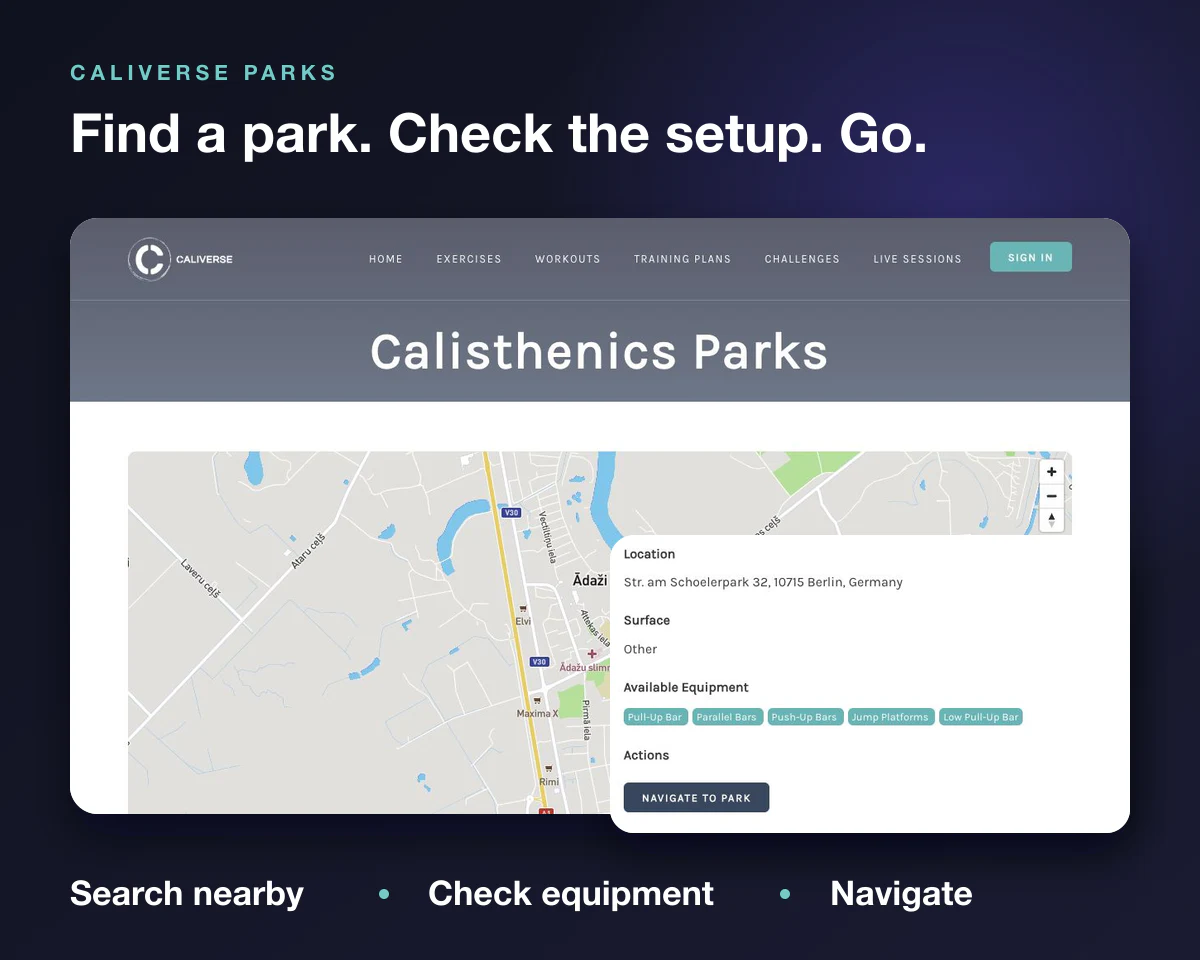
Looking for a calisthenics park near you? Open the Caliverse park map, move to the area where you want to train, and open a park listing to check its location, surface, equipment, and directions. The closest park is not always the most useful one, so choose a location that supports the exercises you can do now.
Find a calisthenics park near you with Caliverse
What is a calisthenics park?
A calisthenics park is an outdoor training area built around bodyweight exercise. It usually includes some combination of pull-up bars, low bars, parallel bars, push-up handles, platforms, and open ground. You may also see the terms outdoor gym, street workout park, or workout park. Outdoor gyms sometimes include fixed resistance machines, while calisthenics parks tend to focus more on bars and open-ended movement.
You do not need every type of station to get a useful workout. A stable bar, enough clear space, and exercise choices suited to your level are more valuable than a long equipment list you cannot yet use.
How do you find a calisthenics park near you?
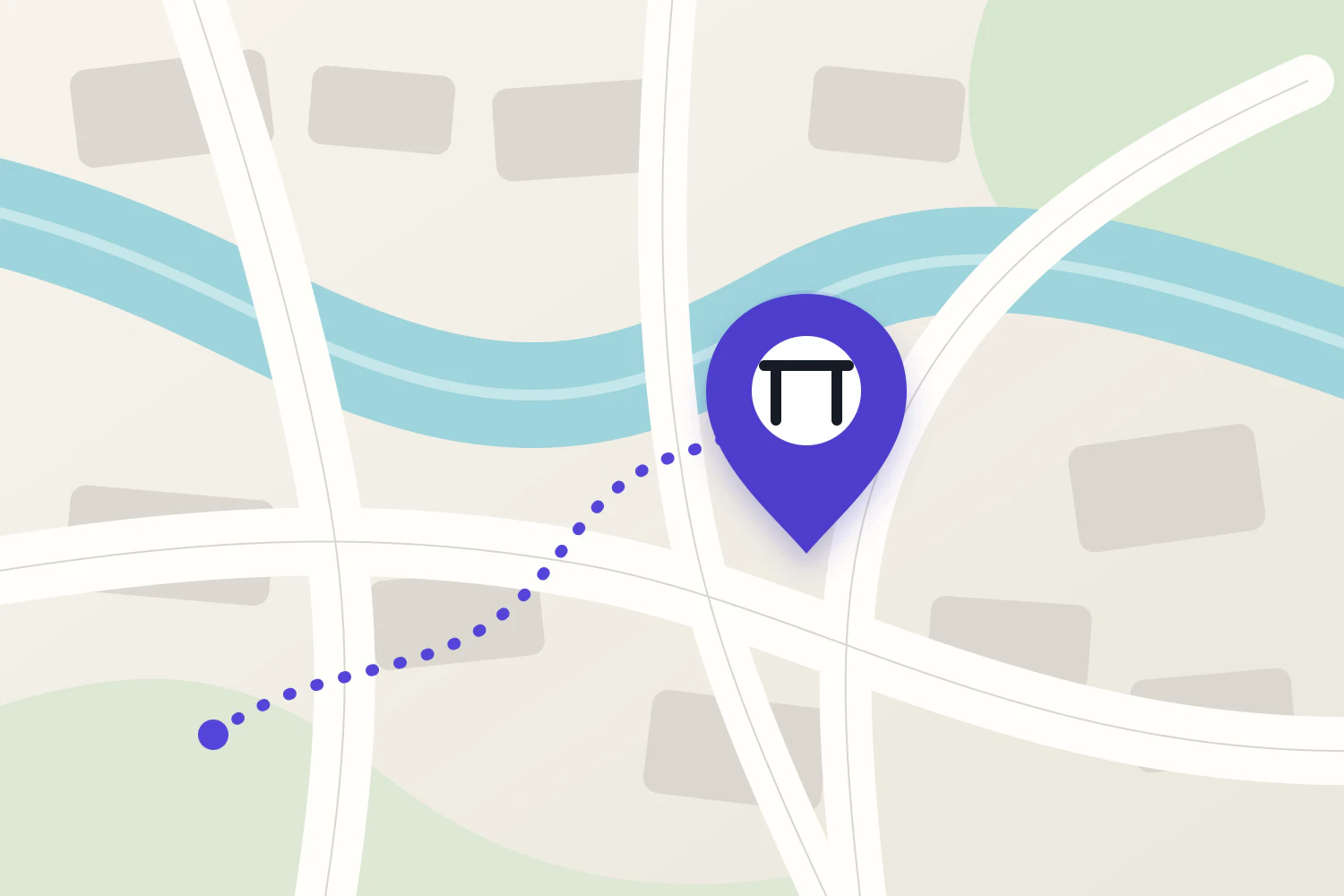
The current Caliverse directory contains hundreds of outdoor training locations. Its web map lets you explore an area, while the park list can be searched by park name. Each available listing can then provide practical details before you travel.
- Open the Caliverse park directory. Use the map to explore the city or area where you want to train.
- Search by name when you know the park. This is useful when someone recommends a location or you have seen its name elsewhere.
- Open a park listing. Check the recorded location, surface, and available equipment.
- Use the directions option. Confirm the route and any local access information before leaving.
Park information can change. Equipment may be repaired, removed, wet, busy, or temporarily unavailable, so treat the directory as a planning tool and inspect the location when you arrive.
What should you look for in an outdoor workout park?
The best park for you is the one that makes your next workout practical. Check these five things before committing to a location.
1. Equipment that matches your current level
A high pull-up bar is useful once you can hang or work on assisted pull-ups. A low bar can be even more valuable for a beginner because it supports more upright body rows. Parallel bars open up support work and dip progressions, while open ground covers squats, split squats, push-ups, and planks.
2. Stable bars and enough clearance
Look for secure supports, intact grips, and space to move without hitting another station, a fence, or another person. Skip equipment that is visibly loose, damaged, excessively hot, icy, or too slippery to hold confidently.
3. A usable surface
Rubber, grass, sand, concrete, and other surfaces all change how the area feels. The important questions are whether the ground is even, whether it drains after rain, and whether you can place your hands and feet securely for the exercises you intend to perform.
4. Access and surroundings
Check the route, lighting, shade, opening hours, and local rules. Many public outdoor gyms are free to use, but that is not universal. Choose a time and place where you feel comfortable, especially when training alone.
5. A realistic next session
A park filled with advanced equipment is not automatically better. If one park has a low bar, clear ground, and a quiet training area, it may be more useful than a larger park designed around advanced skills.
Which exercises can you do with common park equipment?
Use this table as a planning guide. Exercise names describe options, not a requirement to perform every movement in one session.
| Equipment | Useful for | Easier starting option |
|---|---|---|
| High pull-up bar | Pull-ups, assisted pull-ups, controlled hanging core work | Feet-assisted repetitions when the setup allows, or a resistance band you already know how to use |
| Low pull-up bar | Body rows and horizontal pulling | A more upright body row with your feet closer to the bar |
| Parallel bars | Support holds, dip progressions, and controlled knee raises | A brief support hold or feet-assisted repetition |
| Push-up bars | Push-up variations and support work | An incline push-up using a stable higher surface |
| Platform or step | Step-ups and controlled lower-body work | A low step-up without jumping |
| Open ground | Squats, split squats, push-ups, planks, and mobility work | Shorter ranges of motion that remain comfortable and controlled |
Bodyweight exercises are a valid form of resistance training. The American College of Sports Medicine’s 2026 guidance emphasizes that bodyweight and other accessible training methods can improve strength and function. Consistency and a plan suited to the individual matter more than unnecessary complexity.
If you are completely new, start with our beginner guide to calisthenics. If muscle growth is your priority, see the evidence-based calisthenics muscle-building guide.
What is a good first calisthenics park workout?
A good first session should help you learn the park and finish with enough energy to train again. It is not a test of how many difficult repetitions you can force through.
Warm up for 5 to 8 minutes
- Walk or jog at an easy pace.
- Move your shoulders, wrists, hips, and ankles through comfortable ranges.
- Perform a few easy squats and incline push-ups.
- Try one low-effort repetition of your planned pulling movement.
Complete 2 to 3 controlled rounds
- Pull: 6 to 10 body rows, or 3 to 6 assisted pull-ups.
- Push: 6 to 12 incline push-ups or regular push-ups.
- Legs: 8 to 15 squats, or 6 to 10 split squats per side.
- Core: a 20 to 40 second plank, or 6 to 10 controlled knee raises.
Rest as long as you need to make the next set controlled, usually around one to two minutes for this type of session. Choose one option from each movement family and stop each set with roughly two or three good repetitions still available. Training to complete muscular failure is not necessary for the average healthy adult, according to the current ACSM review.
If you cannot yet do a pull-up, that is normal. Use a low bar for body rows, use assistance, or train the other movement families and follow a structured pull-up progression later. Pain, slipping, or loss of control is a reason to stop or change the movement, not a target to push through.
Progress one small thing next time
Record what you did while it is fresh. At the next visit, repeat the session or change one variable: add one or two repetitions, use a slightly harder variation, or complete one additional controlled round. Our guide to building muscle with calisthenics explains how progressive overload applies to bodyweight training.
For general health, the CDC recommends that adults perform muscle-strengthening activity for all major muscle groups on at least two days each week. Your park session can contribute to that total, but the right weekly schedule depends on your current training, goals, and recovery.
How should you prepare for outdoor conditions?
Do a quick check when you arrive: test the surface, inspect the bars, notice the weather, and confirm that you have enough room. Bring water and clothing suited to the conditions. A small towel can help with damp surfaces, but it does not make unsafe equipment usable.
Heat deserves extra attention. The CDC advises people exercising in hot weather to use cooler parts of the day when possible, start slowly, drink water before thirst becomes strong, and stop activity if they feel faint or weak. On a very hot day, reducing the workout or training indoors can be the better choice.
Frequently asked questions about calisthenics parks
Are calisthenics parks free?
Many public calisthenics parks and outdoor gyms are free, but access rules vary. Check the park listing, local signs, opening hours, and any facility-specific restrictions.
Can beginners use a calisthenics park?
Yes, if the park has equipment and exercise options that suit the beginner. Low bars, open ground, incline push-up surfaces, and assisted variations can be more useful than advanced stations.
How do I find a park with pull-up bars?
Use the Caliverse map to locate candidate parks, then open each listing and check its available equipment. Look for a pull-up bar or low pull-up bar before planning a pulling workout.
What if there is no outdoor gym nearby?
You can still train with a no-equipment home or outdoor routine. Avoid using playground structures or other objects that were not designed, maintained, or permitted for adult exercise loads.
What should I bring to a calisthenics park?
Water, weather-appropriate clothing, and a phone with the location saved are enough for many sessions. A resistance band is optional if it is already part of a progression you can use safely.
Are outdoor gyms and calisthenics parks the same?
The terms overlap. A calisthenics park usually emphasizes bars and bodyweight skills. An outdoor gym may also include fixed machines or cardio-style stations. What matters is whether the available equipment supports your planned workout.
Find your next place to train
A useful park removes friction: you know where it is, what equipment is available, and what you will do when you arrive. Start with a simple session, record what felt controlled, and make the next visit slightly easier to plan.
Find a calisthenics park near you with Caliverse, then use Caliverse to keep your bodyweight training structured wherever you train.
About the author : Daniels