

For calisthenics strength, start with 3-8 controlled reps per set. For muscle growth, 6-20 is a useful working range. For muscular endurance, use 15-30 or more. For skill practice and explosive work, keep sets short at about 1-5 high-quality reps.
Those numbers are starting zones, not biological cutoffs. A set of 10 wall push-ups and a set of 10 one-arm push-up progressions do not create the same training demand. The useful range is the one you can reach with a suitable exercise variation, consistent technique, and the right amount of effort for your goal.
This guide is for generally healthy adults. It is a practical framework, not an individualized training or medical prescription.
If you are still choosing your first movements and schedule, start with our complete beginner guide to calisthenics.
Why calisthenics rep ranges work differently
With a barbell or machine, you can change the load by adding or removing weight. In calisthenics, the number on the weight stack is replaced by the exercise variation.
Leverage, range of motion, body angle, assistance, stability, tempo, and external weight can all change how demanding one repetition is. Elevating your hands makes a push-up easier. Elevating your feet usually makes it harder. Moving your feet farther from the anchor makes an inverted row more demanding. A band can provide assistance in a pull-up, while a weight belt can add resistance.
That is why the question is not only, “How many reps should I do?” It is also, “Which variation puts those reps in the right difficulty zone?” Our guide to exercise progressions and regressions explains how to adjust an exercise while preserving the movement pattern.
Small calisthenics studies support this general principle, although they do not prove a universal formula. One eight-week study in 18 young men found similar upper-body strength and muscle changes from low-load bench press and push-ups adjusted to a comparable relative load. A separate four-week progressive push-up study found improved upper-body strength in a sample of 23 participants. Both studies were short, small, and limited to push-up training, so their results should not be generalized to every exercise or person.
Calisthenics rep ranges by goal
The current American College of Sports Medicine position stand and large reviews of resistance training point in the same broad direction: heavier resistance has an advantage for maximal strength, while muscle growth can occur across a wider loading range. Muscular endurance is trained more specifically with longer sets and lighter resistance.
| Goal | Practical starting range | Choose a variation that… |
|---|---|---|
| Strength | 3-8 reps | Feels demanding while every rep stays controlled |
| Muscle growth | 6-20 reps | Lets you accumulate hard, repeatable sets |
| Muscular endurance | 15-30+ reps | Lets you sustain the movement and cadence |
| Skill or power | 1-5 quality reps | Preserves speed, position, and technical consistency |
Strength: 3-8 controlled reps
Strength training should make a small number of controlled repetitions difficult. If you can perform 20 clean repetitions of an exercise, that variation is unlikely to be the most specific choice for improving maximal strength.
Move to a harder progression, change your leverage, or add external resistance when the current variation is clearly too easy. A 2021 systematic review and meta-analysis found that higher-load training produced larger gains in one-repetition maximum strength than lower-load training, even though muscle growth was similar. A 2023 network meta-analysis reached a similar conclusion: many resistance-training prescriptions improved strength, but higher-load training ranked best for maximizing it.
Do not force a progression that changes your range of motion or position on every rep. Three consistent assisted pull-ups are more useful than three unassisted attempts that start from different positions and end with uncontrolled kicking.
Muscle growth: 6-20 is practical, but the effective range is wider
For most calisthenics exercises, 6-20 reps is a useful hypertrophy range because it balances exercise difficulty, set length, and technique. It is not a hard limit. Research comparing resistance-training loads shows that muscle growth can occur with both heavier and lighter loads when the sets provide a sufficiently challenging stimulus.
A review of the repetition continuum concluded that a broad range of loads can build muscle, so roughly 5-30 reps can work as a practical interpretation. The ends of that range have tradeoffs. Very low repetitions require a difficult variation and may limit how much useful work you can perform. Very high repetitions can become uncomfortable or limited by balance, breathing, or local endurance before the target muscles receive the intended stimulus.
You also do not need to take every set to failure. A systematic review and meta-analysis of failure versus non-failure training found no consistent requirement to reach momentary failure for strength or muscle growth. As a practical starting point, finish most stable working sets when you estimate that about 1-3 clean repetitions remain. Treat that estimate as a guide, not a precise measurement.
If muscle growth is your main goal, see our complete guide to building muscle with calisthenics for weekly volume and a full hypertrophy progression method.
Muscular endurance: 15-30 reps or more
Endurance training asks you to sustain repeated contractions and maintain output as fatigue accumulates. Choose an easier variation that lets you work for longer without turning the last repetitions into a different movement.
The exact target should match the task. If you want more repeatable push-ups, train enough push-ups to challenge repeat performance. If you want longer support holds, time under tension may be more useful than counting repetitions. Sets above 30 can have a place, especially when the movement is stable and the goal is specific, but adding difficulty is often a more efficient progression when the set becomes very long.
Skill practice and explosive work: 1-5 high-quality reps
Skill and power sets are limited by quality rather than muscular failure. Handstand entries, explosive pull-ups, box jump muscle-up transitions, and similar movements become less useful when fatigue changes the position or slows the action.
Use short sets, take enough rest to repeat the movement well, and stop before speed or control fades. These repetitions are practice, not a promise that the same range will maximize muscle growth or endurance.
Use the variation-fit test
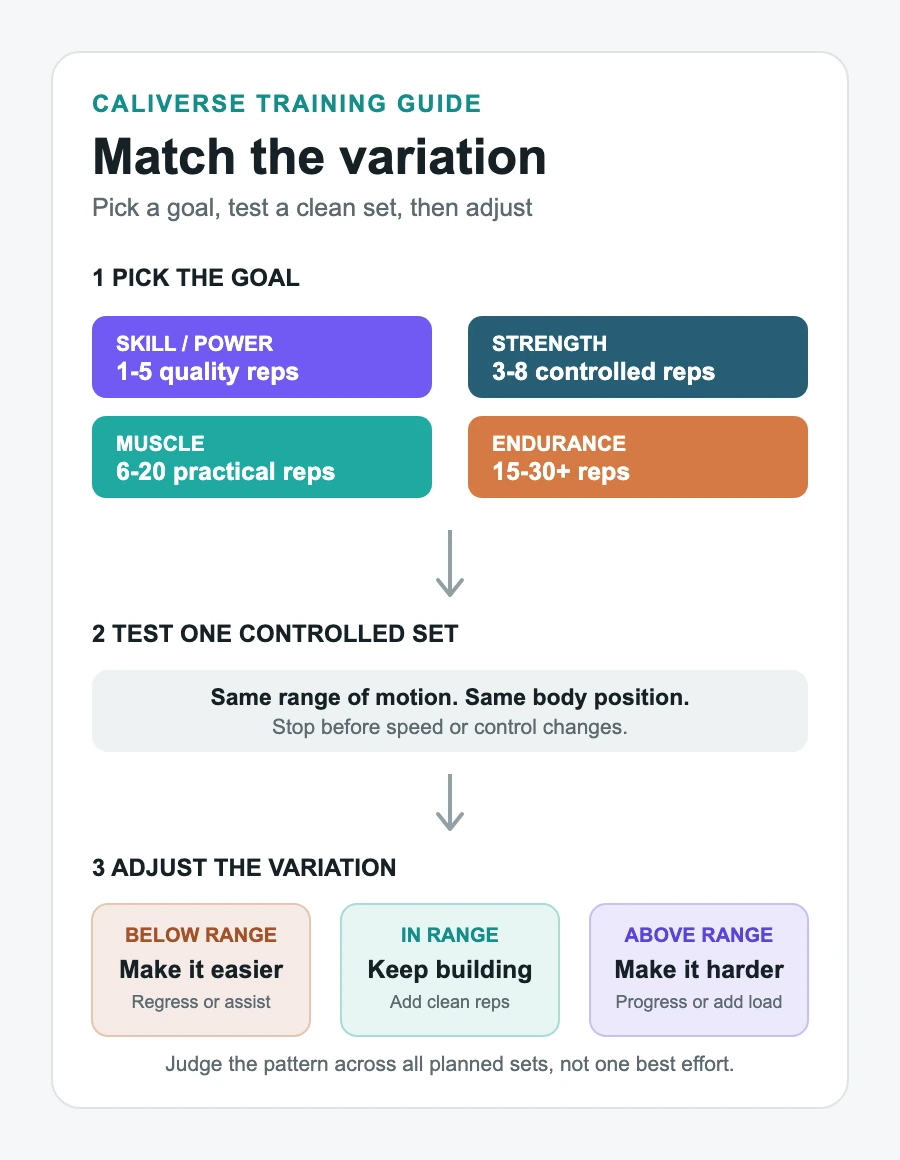
Choose your goal first, then test whether the exercise variation matches it. Use a warm-up set before judging a difficult movement.
- Perform a controlled set. Keep the same range of motion and body position from the first rep to the last.
- Stop before technique changes. Note the repetitions completed and estimate how many equally clean reps were still available.
- Compare the result with the target zone. If you cannot reach the lower end, use an easier variation, more assistance, or less external load. If you pass the upper end with several clean reps available, choose a harder variation or add load.
- Confirm it across multiple sets. A variation fits when you can repeat useful sets without the target range collapsing after the first effort.
For example, suppose your muscle-growth target is 8-15 inverted rows. If you complete 15 clean reps and could have performed several more, make the body angle harder next time. If you can only complete five controlled reps, raise the bar or shorten the lever. If you complete 11, 10, and 9 challenging reps with stable technique, keep the variation and build from there.
How to progress from one session to the next
Keep the exercise and technique standard stable long enough to measure a trend. Then progress one variable at a time.
- Add repetitions within the range. A sequence such as 8, 8, 7 can become 9, 8, 8 before the exercise changes.
- Make the variation harder after you own the top of the range. Progress when you can reach the upper target across your planned sets with consistent technique and some clean capacity remaining.
- Add a set when more weekly work serves the goal. Do not add sets automatically. First check whether the current sets are repeatable and whether your next sessions remain productive.
- Add external load when it is the clearest progression. Weighted pull-ups and dips can make resistance easier to measure, but they are options rather than requirements. Our comparison of weighted and bodyweight training explains the tradeoffs.
If you move to a harder variation and fall below the lower end of your target, the jump may be too large. Use a smaller leverage change, assistance, or a mix of the harder and easier variations instead of accepting low-quality repetitions.
Three practical examples
Push: choose the push-up angle for the goal
If incline push-ups allow 25 clean reps, they may suit an endurance set. For a muscle-growth set, lower the hand support until 8-15 controlled reps are challenging. For strength, a decline, ring, pseudo planche, or weighted variation may bring the set into the 3-8 range. The right option depends on which progression you can perform consistently.
Pull: adjust assistance or leverage
If you cannot complete three controlled pull-ups, use a band, foot support, or rows to build useful volume. If 12 pull-ups are comfortable and strength is the goal, a harder progression or external load may be more specific than chasing 20. For rows, moving the feet farther forward or elevating them increases the demand without changing the movement family.
Legs: do not let balance decide the set
Bodyweight squats can quickly become a long endurance set. Split squats, step-ups, assisted single-leg squats, or added load can make lower repetition ranges challenging. Use support when balance ends the set before the working muscles do. Stability is a real requirement, but it should not accidentally replace the intended strength or muscle stimulus.
Common rep-range mistakes
Chasing the number after technique changes
If the first eight reps are controlled and the next four shorten the range of motion, you did not complete 12 equivalent reps. Set a clear technique standard and count only repetitions that meet it.
Taking every set to failure
Failure can be used selectively on stable exercises, but it is not required for every set. Repeated failure can reduce the quality of later sets and make weekly workload harder to manage. Stop earlier on technical, explosive, or high-consequence movements.
Keeping an easy variation for endless repetitions
More repetitions are not always the best next step. If your goal is strength or muscle growth and sets have become very long, increase the difficulty so the target muscles become the limiting factor again.
Changing the exercise too often
Variation is useful when it changes the training demand for a reason. Changing the exercise every session makes it difficult to tell whether your repetitions, control, or capacity are improving.
Comparing unlike variations
Ten ring push-ups are not directly comparable with ten floor push-ups. Record the exercise variation, assistance, range of motion, and added load alongside the repetition count.
Track the variation, sets, and repetitions
A useful training log records more than the final repetition total. Note the exact variation, the repetitions in each set, any assistance or external load, and whether the technique standard stayed consistent. That gives you enough context to decide whether to add reps, keep the exercise, or move to another progression next time.
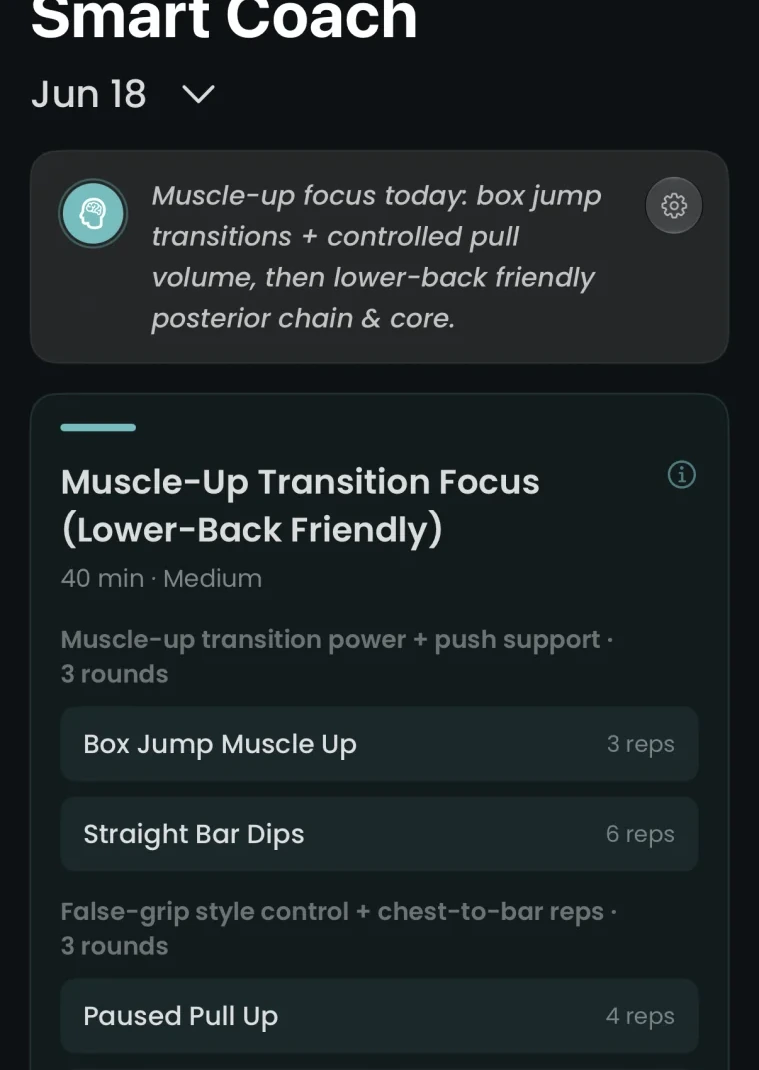
A current Caliverse workout screen keeps the exercise variation and planned repetition target together. Caliverse also lets you add exercises to a workout, follow progressions, and track your sets. Use that record to keep the target range connected to the variation you actually performed.
Track your sets and progressions with Caliverse
Frequently asked questions
Is 5, 8, 10, or 20 reps best for calisthenics?
None is best for every goal. Five difficult reps can fit strength work, 8-20 often fits muscle-building work, and 20 or more can fit muscular endurance. Match the exercise variation to the goal and count only controlled repetitions.
Can high reps build muscle?
Yes. Research shows that muscle growth can occur across a broad range of resistance-training loads when sets are sufficiently challenging. In practice, very high-rep calisthenics sets may be limited by discomfort, balance, or endurance, so a harder variation can make the set more efficient.
Should every calisthenics set go to failure?
No. Most sets can stop with about 1-3 clean repetitions estimated to remain. Failure is optional and better suited to stable movements than technical skills, explosive exercises, or variations where a missed rep has a higher consequence.
When should I choose a harder progression?
Choose a harder progression when you can reach the top of your target range across the planned sets with consistent technique and several clean reps still available. If the new variation puts you below the lower end, use a smaller progression step or assistance.
Do slow reps change the target range?
Slower repetitions increase the time and fatigue of each rep, so you may complete fewer. Keep the tempo controlled and consistent enough to compare sessions. Deliberately slow reps can be useful, but they do not replace suitable resistance, range of motion, and progression.
Sources
- ACSM position stand on resistance-training prescription
- Systematic review and meta-analysis of resistance-training load
- Network meta-analysis of resistance-training prescriptions
- Systematic review and meta-analysis of failure versus non-failure training
- Review of the resistance-training repetition continuum
- Study comparing load-matched push-ups and bench press
- Study of progressive calisthenic push-up training
About the author : Daniels