
Yes, calisthenics can build muscle. Your muscles respond to challenging resistance, sufficient training volume, and progression over time. That resistance can come from a barbell, a resistance band, or your own body weight.
Written by Daniels. Updated July 30, 2026.
The catch is that simply doing more easy push-ups is not a muscle-building plan. You need exercises that challenge the target muscles, sets that finish reasonably close to your current limit, and a progression method that keeps the work demanding as you get stronger.
The American College of Sports Medicine’s 2026 resistance-training guidance supports bodyweight exercise as an effective form of resistance training. It also emphasizes a useful point: consistent training matters more than building an unnecessarily complicated program.
Why calisthenics can build muscle
Muscle growth, also called hypertrophy, is an adaptation to repeated resistance training. The equipment is not the main signal. What matters is whether the working muscle must produce enough force, whether you repeat that work often enough, and whether the challenge increases as you adapt.
There is direct, although limited, research on bodyweight exercise. In one small eight-week study, load-matched push-ups and bench presses produced similar increases in chest and triceps muscle thickness. That does not prove every bodyweight exercise is equivalent to every weighted exercise, but it demonstrates the core principle: a properly loaded push-up can provide a muscle-building stimulus.
Calisthenics does have practical limitations. External weights make small load increases easier to measure, and they can be especially useful for strong trainees, leg training, and muscles that are difficult to isolate with bodyweight alone. This is a programming difference, not evidence that calisthenics “doesn’t count.” A bodyweight-first or hybrid plan can both work. Our guide to common calisthenics misconceptions addresses several related myths.
The four rules of calisthenics hypertrophy
1. Choose a variation that challenges the right muscles
An exercise is useful for hypertrophy when the target muscles are the reason the set becomes difficult. If balance, grip, fear, or an awkward setup ends the set first, choose a more stable variation.
For example, a standard push-up may be too hard for a beginner and too easy for an advanced trainee. The beginner can elevate their hands. The advanced trainee can use a decline, rings, a deficit, or added load. The movement pattern is similar, but the resistance now matches the person performing it.
Use a range of motion you can control without pain. Research comparing resistance-training ranges of motion generally favors full movement over cutting every repetition short, although the available evidence is limited and stronger for lower-body exercises. You do not need to force a joint beyond a comfortable position to satisfy a generic form rule.
2. Make the working sets hard enough
A set of 10 repetitions is not automatically effective, and a set of 20 is not automatically too light. The important question is how many clean repetitions you could still perform.
For most working sets, finish when you believe you have roughly one to three controlled repetitions left. Treat that as a practical coaching range, not a precise biological threshold. A systematic review of proximity to failure did not find that reaching momentary failure was superior to stopping earlier for hypertrophy. Constant failure training can also add fatigue that makes later sets and future workouts worse.
Use technical failure as your boundary: the point at which the next repetition would require losing the intended range, body position, or control. You can occasionally take the final set of a stable exercise closer to that point. There is little reason to do it on a high-skill or uncomfortable movement.
3. Accumulate enough useful work each week
The 2026 ACSM guidance uses roughly 10 weekly sets per muscle group as a useful hypertrophy target, while a newer dose-response meta-analysis finds that additional weekly volume tends to produce diminishing returns. More can help, but each added set is usually worth less than the one before it.
You do not need to start at 10 direct sets for every muscle. A beginner can begin with about six challenging weekly sets for each main movement category, then add work if performance, sleep, joints, and motivation remain good. Compound exercises overlap: push-ups train the chest, triceps, and front of the shoulders, while chin-ups train the back and elbow flexors.
Training a muscle across two or three weekly sessions is often a convenient way to distribute the work. Frequency is mainly an organizational tool for hypertrophy once weekly volume is considered, so choose a schedule you can repeat.
4. Record performance and progress deliberately
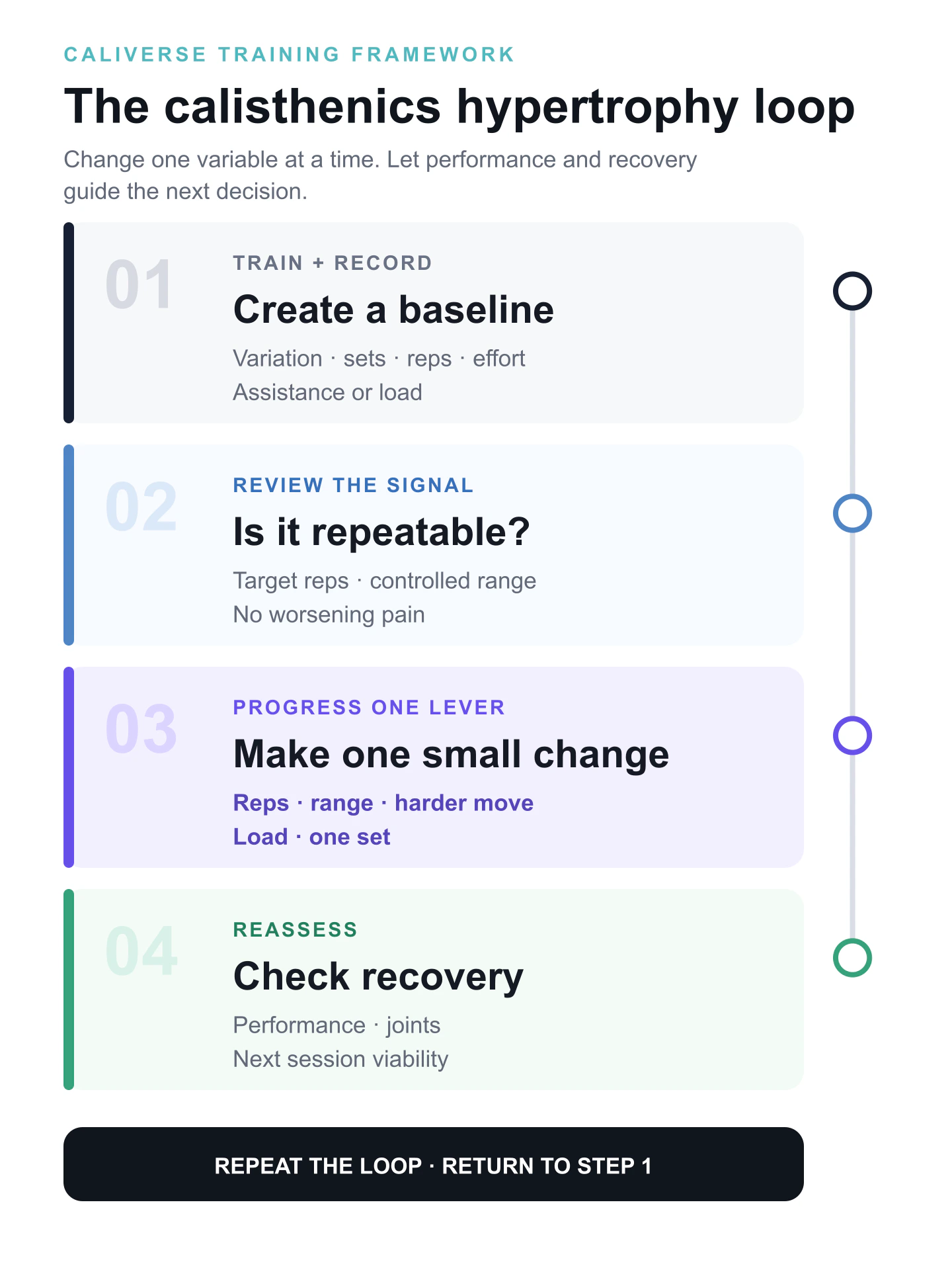
If you do not record the variation, repetitions, sets, and any added load, it is difficult to tell whether the program is progressing. The goal is not to make every workout different. The goal is to repeat useful movements long enough to improve them.
A simple log should tell you:
- which exercise variation you performed;
- how many controlled repetitions you completed in each set;
- how many repetitions you estimate were left;
- how much assistance or external load you used;
- whether pain or an unusual recovery problem affected the session.
A practical three-day calisthenics muscle-building plan
This template trains the main movement categories three times per week without requiring the same exercises in every session. Leave at least one recovery day between workouts, such as Monday, Wednesday, and Friday.
Beginners can start with two work sets per exercise. Intermediate trainees can use three. Choose a variation that keeps most sets within the suggested range and leaves approximately one to three clean repetitions in reserve.
Day 1
- Push: Incline or standard push-up
- Pull: Assisted pull-up or chin-up
- Knee-dominant legs: Reverse lunge
- Posterior chain: Hip bridge
- Trunk: Dead bug or hollow-body hold
Day 2
- Push: Pike push-up
- Pull: Bodyweight row
- Knee-dominant legs: Squat or step-up
- Posterior chain: Sliding leg curl
- Trunk: Side plank
Day 3
- Push: Push-up or assisted dip
- Pull: Chin-up or harder row
- Knee-dominant legs: Bulgarian split squat
- Posterior chain: Single-leg hip bridge
- Trunk: Hanging knee raise or reverse crunch
Starting repetition ranges
- Push: 6–15 reps
- Pull: 5–15 reps
- Knee-dominant legs: 8–20 reps per side
- Posterior chain: 8–20 reps
- Trunk: 8–15 reps or 20–40 seconds
Warm up with easier versions of the first movements and a few gradually harder practice sets. A 2024 review of rest intervals found a small possible hypertrophy benefit to resting more than 60 seconds, with unclear additional effects beyond 90 seconds. As a practical starting point, rest for about two to three minutes after demanding compound sets and one to two minutes after simpler movements. Rest longer if short breaks reduce your repetitions sharply or make technique deteriorate.
The exercise names are options, not requirements. Use a stable setup that fits your body and equipment. If you do not have a secure bar, rings, or band anchor for pulling work, do not improvise with unstable furniture.
How to apply progressive overload without a barbell
Progressive overload means increasing the training demand as your current workout becomes easier. In calisthenics, you have more options than simply adding repetitions forever.
- Add repetitions. Keep the same variation until you reach the top of your target range across all sets with controlled technique.
- Improve range and control. Use the intended range without bouncing, shortening later repetitions, or turning the movement into a different exercise.
- Choose a harder variation. Raise the feet in a push-up, reduce assistance in a pull-up, or move from a bilateral squat to a supported single-leg variation.
- Add external load. A weight vest, belt, or carefully loaded backpack can create smaller progression steps when bodyweight variations jump too quickly.
- Add a set when needed. Increase volume only when progress has stalled and recovery is still good. Do not add sets automatically every week.
A slower tempo can help you remove momentum and maintain control, but it is not a separate guarantee of growth. If deliberately slow repetitions reduce the useful load or total work too far, they can make progression harder to measure.
A simple double-progression method
Suppose you perform three sets of standard push-ups with a target of 8–15 repetitions. Your first workout is 12, 10, and 9 controlled reps. Keep the same variation until you can perform 15, 15, and 15 with one to three good repetitions still available. Then choose a slightly harder variation or add a small amount of load and return to the lower end of the range.
If the same exercise stalls for two or three exposures, do not immediately assume you need more intensity. Check sleep, food intake, exercise setup, and whether other exercises are already training the same muscles. If recovery is good, add a set or make a small variation change. If several exercises regress at once and fatigue is accumulating, reduce the number of sets for a week instead.
When weights make muscle building easier
Calisthenics can be the foundation of a muscle-building program without becoming a rule against weights. External resistance is useful when:
- the next bodyweight progression is too large;
- high-repetition leg exercises become limited by breathing or discomfort before the target muscles;
- you want more direct work for a specific muscle;
- measuring small load increases matters more than learning a harder skill;
- a weighted variation is more comfortable and stable for you.
Weighted pull-ups, weighted dips, goblet squats, and Romanian deadlifts can sit comfortably inside a calisthenics program. If you want a fuller comparison, read our guide to weighted training versus bodyweight training.
Nutrition and recovery for muscle growth
Training creates the reason to adapt. Food and recovery provide the conditions.
Eat enough total food to support training and stable recovery. A meta-analysis of resistance training during energy deficits found that prolonged deficits impaired lean-mass gains even when strength gains could still occur. At the same time, a review of energy surplus and hypertrophy found that research has not established one universal calorie surplus for maximizing muscle growth. Use changes in body weight, training performance, hunger, and recovery together instead of forcing a generic bulking target.
Protein matters, but supplements are optional. A large meta-analysis found that protein supplementation modestly improved resistance-training gains and that intakes beyond roughly 1.6 grams per kilogram of body weight per day did not add further fat-free-mass gains in the included data. For a healthy adult focused on muscle gain, about 1.6 g/kg/day is a reasonable reference point, not a requirement to exceed. People with medical or dietary constraints should get individualized guidance.
Sleep and rest days also affect how much useful training you can repeat. Persistent joint discomfort, declining performance across several sessions, or fatigue that interferes with daily life is a reason to adjust the plan, not a badge of a successful workout. Sharp or worsening pain should not be trained through.
How to know whether your plan is working
Strength performance usually gives faster feedback than the mirror. If you can perform more controlled repetitions, use less assistance, or handle a harder variation in the same rep range, the program is producing an adaptation.
Review the trend every four to six weeks:
- Are repetitions or exercise difficulty increasing?
- Are the target muscles doing the work?
- Are most sessions repeatable without excessive soreness or joint irritation?
- Are body measurements or consistent progress photos changing over a longer period?
- Has the plan become too easy, too tiring, or simply difficult to follow?
Do not rewrite the program because of one poor workout. Look for a repeated trend.
Turn the framework into a plan you can follow
Caliverse Smart Coach builds workouts around your goal, experience, and available equipment, then adjusts the training week as you progress. That makes it easier to apply the principles above without manually rebuilding every session.
Build your muscle-focused training week with Caliverse
Frequently asked questions
Can beginners build muscle with calisthenics?
Yes. Beginners are often in a strong position to progress because basic movements still provide meaningful resistance. Start with stable variations that let you train the intended muscles through a comfortable range, then make the exercise harder as performance improves.
Is calisthenics enough for leg growth?
It can build leg muscle, especially for beginners, but progression can become less convenient than upper-body calisthenics. Single-leg squats, split squats, step-ups, sliding leg curls, and calf raises extend the runway. External load becomes useful when repetitions climb too high or the next bodyweight variation is not practical.
Do I need to train to failure?
No. Sets should be challenging, but reaching momentary failure on every set is not required for hypertrophy. Finishing most work sets with approximately one to three controlled repetitions left is a practical starting point. Stable exercises can occasionally be taken closer to technical failure.
How many repetitions should I do?
Use a range that lets the target muscles limit the set while technique stays controlled. Six to 15 repetitions works well for many upper-body movements, while leg and smaller accessory exercises may remain practical at higher repetitions. Progress the variation when the top of the range becomes repeatable.
How long does it take to see results?
There is no reliable universal deadline. Training experience, genetics, food intake, sleep, and the starting point all affect the rate. Look for improving performance first, then assess measurements or consistent photos over months rather than days.
Do I need equipment?
You can start pushing, squatting, lunging, and trunk work without equipment. A secure pull-up bar, rings, or resistance band makes balanced pulling work and long-term progression much easier. Added load can help later, but it is not required to begin.
Sources
- ACSM position stand on resistance-training prescription
- Meta-analysis of weekly resistance-training volume and frequency
- Load-matched push-up and bench-press study
- Systematic review of proximity to failure and hypertrophy
- Systematic review of range of motion and muscle development
- Systematic review of inter-set rest and hypertrophy
- Meta-analysis of energy deficit and resistance-training outcomes
- Review of energy surplus and muscle hypertrophy
- Meta-analysis of protein supplementation and resistance training
About the author : Daniels