

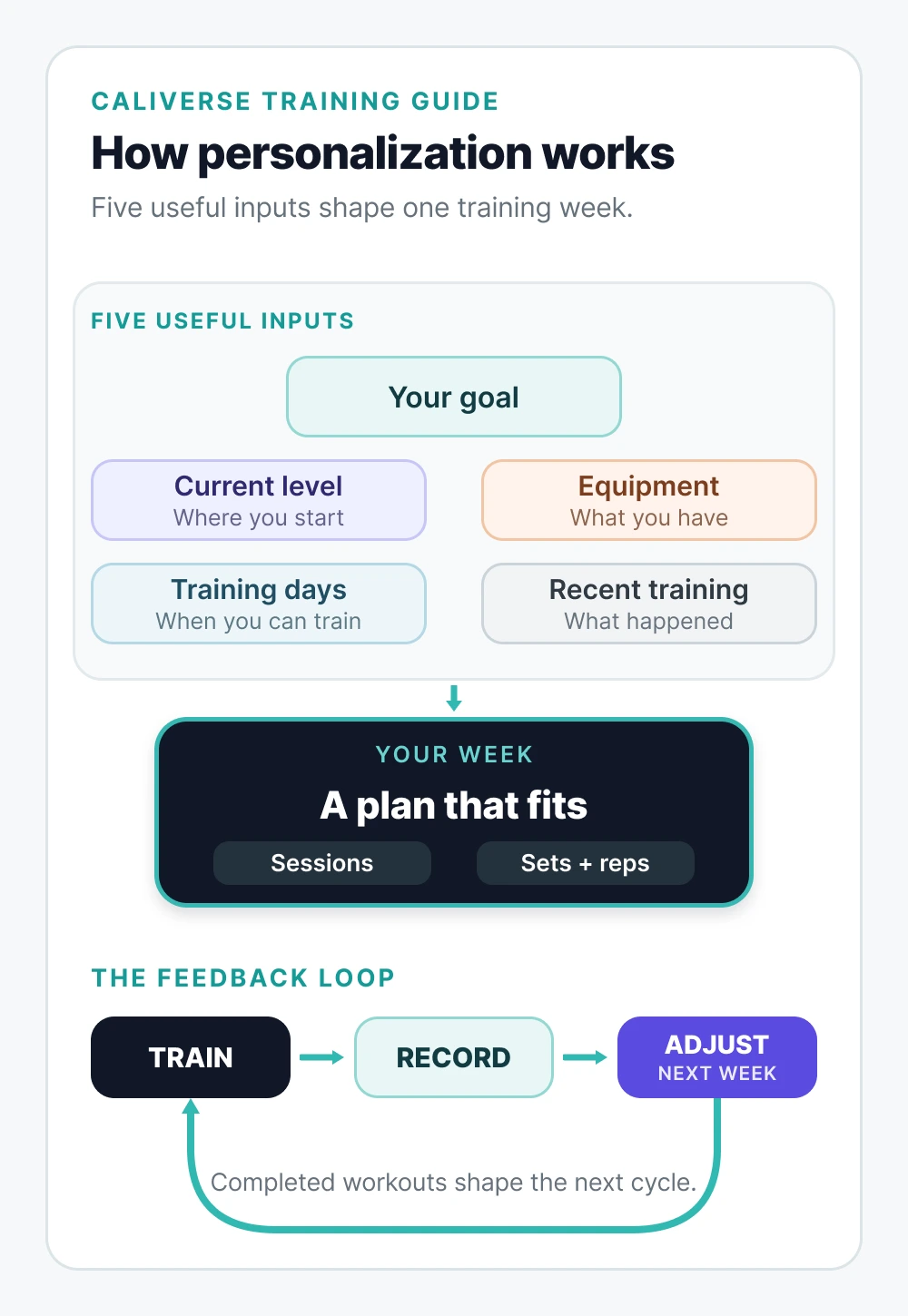
A personalized calisthenics plan starts with five useful inputs: your goal, current level, available equipment, realistic training days, and what happened in your recent workouts. Those inputs should shape the exercises you receive, how difficult they are, how the week is organized, and what changes next.
That is the practical idea behind Caliverse Smart Coach. You tell it what you want to achieve and what you can work with. It builds your week, then uses your completed training to keep future planning relevant.
The framework below explains the decisions a useful personalized plan needs to make. It is not a technical description of Smart Coach’s software, and the example week is illustrative rather than a guaranteed output.
What makes a calisthenics plan personalized?
A personalized plan is not simply a long list of workouts with your name attached. It should answer five practical questions:
- What are you training for?
- Which exercise variations can you perform now?
- Which equipment can you use consistently?
- When can you realistically train?
- What did you actually complete?
The first four questions give the plan its starting shape. The fifth keeps it connected to reality.
This matters because a plan can be excellent on paper and still be wrong for the person following it. A four-day program is not useful when you can reliably train twice. Ring exercises do not belong in every session if you only have rings on weekends. A muscle-up goal needs a different progression path from a general fitness goal.
The 2026 American College of Sports Medicine resistance-training guidance makes the same broad point: train progressively, match the work to the goal, and choose a routine that fits your schedule and abilities. It also emphasizes that consistency matters more than making a program unnecessarily complicated.
The five inputs behind a useful plan
1. Your goal sets the direction
“Get better at calisthenics” is a reasonable ambition, but it is too broad to organize a week. A useful plan needs a clearer destination: build strength, gain muscle, achieve a first pull-up, improve a handstand, prepare for a fitness test, or train consistently without a specific skill target.
The goal changes what receives priority. Someone working toward a pull-up needs regular vertical pulling practice and suitable progressions. Someone training for muscle growth needs enough repeatable weekly work across the major movement patterns. Someone trying to establish a habit may benefit more from shorter sessions that are easier to keep.
If muscle growth is your main goal, our guide to calisthenics rep ranges explains how exercise difficulty and repetition targets work together.
2. Your level chooses the starting variations
Two people can share the same goal and still need different exercises. A beginner may build toward pull-ups with rows, supported hangs, and assisted repetitions. A more experienced trainee may use harder pull-up variations or added load.
The starting variation should be difficult enough to serve the goal but controlled enough to repeat with consistent technique. It should also leave room to progress. Our guide to exercise progressions and regressions explains how changing leverage, assistance, range of motion, and stability can scale a movement.
If you are still choosing your first exercises, begin with the complete Caliverse beginner guide before adding more complexity.
3. Your equipment defines the available options
Calisthenics can start with the floor, but equipment changes the menu. A pull-up bar opens vertical pulling and hanging work. Rings add adjustable rows, support work, and more demanding stability. Resistance bands can provide assistance or additional resistance.
A personalized plan should use the equipment you can actually access—not the equipment you might occasionally find. If you train at home during the week and visit a park on Saturday, the week can reserve bar-dependent work for Saturday instead of giving you unusable sessions.
4. Your training days make the plan realistic
The schedule should start from your calendar rather than an idealized fitness routine. Two dependable sessions beat four planned sessions that repeatedly get skipped.
For general health, both the World Health Organization and current ACSM guidance recommend muscle-strengthening work on at least two days each week. That is a public-health starting point, not a universal optimum. Your goal, training history, session length, and recovery determine whether two, three, or more days make sense.
Training frequency also affects how the work is distributed. With two days, full-body sessions are usually practical. With three days, a plan can alternate emphasis while still training the main movement patterns regularly. With more days, each session may be shorter or more specialized—but more days do not automatically make the plan better.
Our guide to calisthenics rest days can help you place recovery around the schedule you choose.
5. Recent training closes the loop
A plan becomes adaptive when future decisions use what you actually completed. If a session was completed as planned, the next week may keep the movement stable and build gradually. If the assigned variation was clearly too difficult, the next useful decision may be more assistance, lower volume, or a smaller progression step. If your schedule or equipment changes, the week may need to be reorganized.
That does not mean every workout should be completely different. Constant novelty makes progress hard to measure. An adaptive plan still needs continuity: a stable goal, recognizable movement patterns, and enough repeated exposure to see whether you are improving.
How those inputs become a training week
Consider an illustrative trainee with this setup:
- Goal: achieve a first controlled pull-up
- Level: comfortable with bodyweight rows and band-assisted pull-ups
- Equipment: a pull-up bar and resistance band
- Training days: Tuesday, Thursday, and Sunday
- Recent training: rows were completed cleanly, while the final assisted pull-up sets lost range of motion
A sensible week might keep vertical pulling as the priority without turning every day into the same workout:
- Tuesday: Assisted pull-up practice plus a balanced full-body session. The priority skill comes first while the trainee is fresh.
- Thursday: Rows, pushing, legs, and core. This builds supporting strength without repeating the hardest pull-up work.
- Sunday: Assisted pull-ups with a manageable variation, then full-body work. This provides a second specific exposure after adequate spacing.
The recent-session note matters. If range of motion broke down, adding more difficult pull-up work would not be the obvious next step. Keeping or slightly increasing assistance may produce better repetitions and more useful practice.
This is only one plausible structure. A real plan may organize the week differently because session duration, exercise history, preferences, and other constraints also matter.
What an adaptive plan changes—and what it should keep stable
Good adaptation is selective. The whole plan should not reset whenever one session feels difficult.
Keep the direction stable
The main goal and progression path need enough time to work. If the goal is a pull-up, the week should continue to include relevant pulling practice. Swapping to unrelated exercises every few days may feel varied, but it weakens the connection between training and progress.
Adjust the dose or difficulty when needed
The useful change may be small: an easier progression, fewer sets, different assistance, or another day between demanding sessions. When training is going well, the best adjustment may be no change at all.
Research on autoregulated resistance training supports this cautious interpretation. A 2022 systematic review and meta-analysis found similar strength improvements from autoregulated and standardized load prescriptions overall. The evidence does not show that an adaptive method is automatically superior. Its practical value is that it can help individualize decisions while preserving a coherent program.
Re-plan when the constraints change
A new schedule, different equipment, or a changed goal can justify a larger update. If you lose access to a pull-up bar for two weeks, the plan needs replacement movements. If you move from general fitness to a muscle-up goal, the weekly priorities need to change.
Pain, injury, or medical limitations are different. An app can organize the information you provide, but it cannot diagnose the cause of pain or decide whether an exercise is medically appropriate. Seek qualified professional advice when that judgment is needed.
Static workout plan or Smart Coach?
A fixed plan is not inherently worse. It can work very well when:
- the goal is clear;
- the required equipment is consistently available;
- the weekly schedule is stable;
- the starting exercises fit your level; and
- the plan includes a clear progression method.
An adaptive plan becomes useful when those conditions change often or when you do not want to make every programming decision yourself. Smart Coach can reduce the gap between “this is a good general program” and “this is the session that fits my current week.”
The important distinction is not static versus intelligent. It is whether the plan is appropriate, repeatable, progressive, and connected to the training you actually do.
How Caliverse Smart Coach builds your plan
The current Caliverse Smart Coach experience asks about your goal, level, equipment, and training days. It uses those choices to build a weekly structure with a session for each training day, including the warm-up, exercises, sets, and repetitions.
As you train, completed workouts provide context for future planning. You can also change your days, equipment, or goal when your situation changes. Smart Coach is designed for both beginners and experienced trainees and can build around floor-only training or equipment such as bars, rings, and bands.
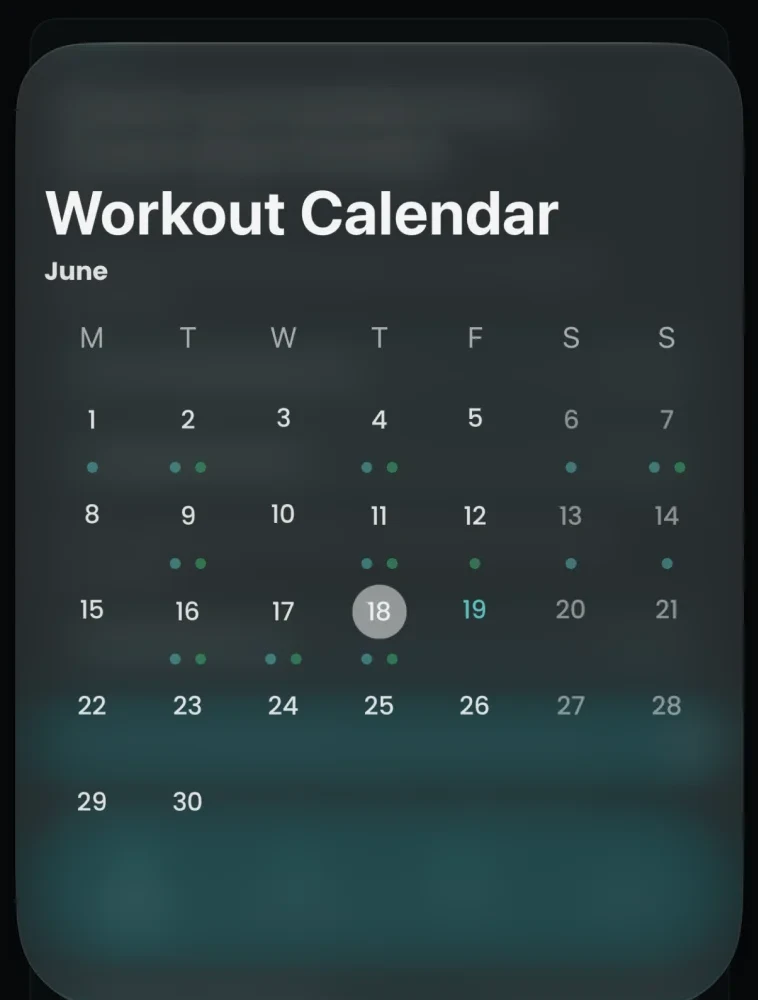
The workout calendar keeps the week visible instead of presenting each session in isolation. The specific sessions still depend on the setup and training context behind the plan.
How to get a more useful Smart Coach plan
- Choose a specific goal. “First pull-up” gives the plan a clearer direction than “get stronger.”
- Enter the equipment you can use consistently. Do not select rings or a bar if you rarely have access to them.
- Pick days you can realistically keep. Build from the minimum dependable schedule. You can expand later.
- Record the workouts you complete. An adaptive plan is more useful when the training record reflects what happened.
- Update changed constraints. If your goal, equipment, or weekly availability changes, update it instead of expecting the old setup to remain suitable.
Frequently asked questions
Is Smart Coach just a workout generator?
No. The public Smart Coach experience is organized around a weekly plan rather than an isolated random workout. It uses your setup choices to plan training days and uses completed training to keep future planning relevant.
Can beginners use Smart Coach?
Yes. Smart Coach is designed to scale from beginner to advanced levels. Beginners should still use controlled progressions and avoid treating a harder exercise as better when the current variation is not yet stable.
Do I need equipment?
No. A plan can be built around floor-based bodyweight training. Adding a pull-up bar, rings, or bands expands the available exercise options, but equipment is not required to begin.
What happens when my schedule changes?
Update the training days so the next plan reflects your current availability. A realistic two-day week is more useful than repeatedly carrying an unrealistic four-day schedule.
Is an adaptive plan always better than a fixed plan?
No. A suitable fixed plan with clear progression can work extremely well. Adaptive planning is most useful when your level, schedule, equipment, or recent performance regularly changes the next sensible decision.
Is Smart Coach available on iOS and Android?
Yes. Caliverse and Smart Coach are available on both platforms. The exercise library and community are free, while Smart Coach and premium plans are included with Caliverse Pro.
Sources
About the author : Daniels