


Start with at least one or two days each week without hard strength training. Beginners often do well with two or three non-consecutive full-body sessions. More experienced trainees may train on more days by spreading push, pull, legs, skills, and easier work across the week.
Written by Daniels. Updated August 14, 2026.
The right number is not fixed. A rest day is useful when it helps you return with stable performance, controlled technique, and no worsening pain. Your exercise selection, weekly volume, experience, sleep, stress, and health all affect how quickly you are ready for the next demanding session.
This guide is for generally healthy adults. It provides starting templates, not medical advice or an individualized recovery prescription.
Why there is no universal 48-hour rule
You may have heard that every muscle needs exactly 48 hours of rest. That is easy to remember, but it is not a biological timer that applies to every workout.
A hard full-body session with unfamiliar movements creates a different recovery demand from a short technique session. Three sets of controlled push-ups are different from a high-volume session that takes every set to failure. An experienced athlete may also tolerate familiar work better than a beginner doing it for the first time.
Research on resistance-training frequency supports flexibility. A systematic review and meta-analysis of hypertrophy studies found no meaningful advantage to higher training frequency when weekly volume was equated. A broader network meta-analysis of resistance-training prescriptions also found that several combinations of load, sets, and frequency can improve strength and muscle growth. Frequency is therefore one way to organize useful weekly work, not a universal recovery rule.
The Physical Activity Guidelines for Americans recommend muscle-strengthening activity on at least two days per week. That is a public-health baseline, not a statement that everyone should train exactly twice or take five complete rest days.
Five factors that change your recovery needs
1. Your training experience
Beginners are learning movements while adapting to a new type of stress. Two full-body sessions per week can be enough to build consistency. A third session can be added when the first two are repeatable and recovery is stable.
More experienced trainees often tolerate more weekly sessions because the movements are familiar and the work can be divided. That does not mean advanced athletes recover instantly. They may also perform more difficult variations, more total sets, or higher-skill work.
2. Your weekly volume and session difficulty
Count hard sets across the week, not just training days. Four demanding sessions can be easier to recover from than three if each session contains less work. Repeatedly taking stable exercises close to your limit also creates more fatigue than stopping with several controlled repetitions available.
If your repetitions, control, or motivation decline across several sessions, adding another hard day is unlikely to solve the problem. Reduce the number of difficult sets, make a session easier, or add recovery time and review the trend.
3. Full-body training versus a split
A beginner doing full-body calisthenics usually benefits from a day between hard sessions because the same movement patterns appear each time. An intermediate trainee might train push on Monday, pull on Tuesday, and legs on Wednesday. That is three consecutive training days, but the main stress is distributed differently.
Splits still overlap. Dips and push-ups both load pressing muscles. Pull-ups and rows both challenge the back and elbow flexors. Skill practice can also be demanding even when it does not look like a conventional workout.
4. New movements and eccentric loading
Unfamiliar exercises and a large increase in controlled lowering work can produce more delayed soreness than your normal routine. The first session after a long break often needs more recovery than the same session several weeks later.
Do not use soreness as the goal. According to the American College of Sports Medicine’s overview of delayed-onset muscle soreness, light activity should not impair recovery, but evidence that it speeds recovery is limited. Progressing a new program gradually is more useful than trying to create or erase soreness.
5. Sleep, illness, stress, and food
Your training plan does not exist separately from the rest of your week. Poor sleep, illness, unusually high life stress, travel, or consistently insufficient food can make a familiar workload harder to repeat.
One tired day does not require rebuilding the program. Look for a pattern. If several sessions feel worse and daily life is also affected, move or reduce the next hard session. Our sleep and performance guide covers the sleep side in more detail.
Three recovery-aware weekly schedules
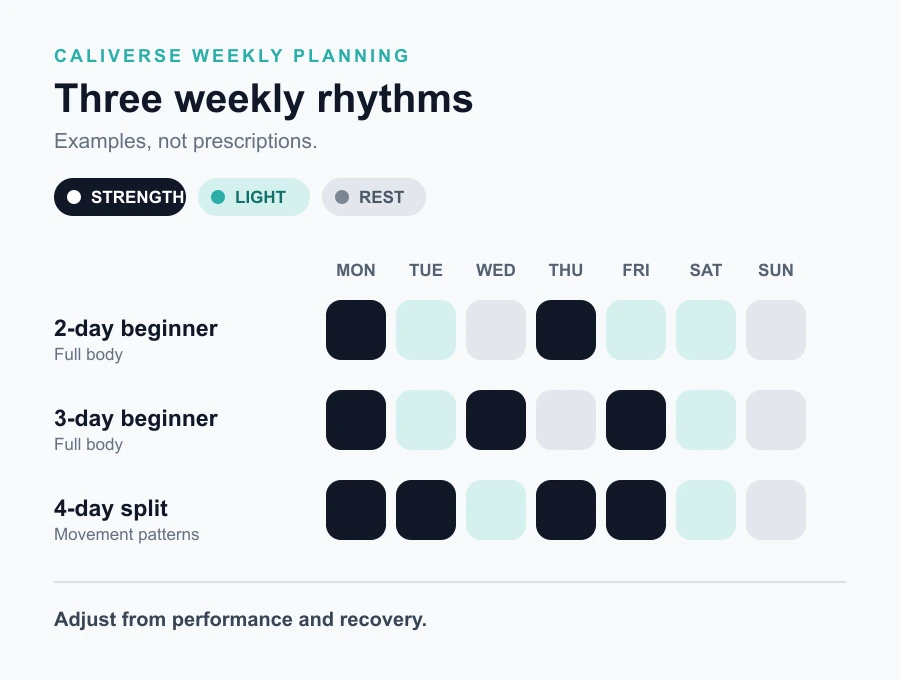
These schedules are starting points. “Light” means easy walking, comfortable mobility, or relaxed skill preparation that does not turn into another hard workout. “Rest” means no planned training is required.
Beginner option: two full-body days
- Monday: Full-body workout
- Tuesday: Rest or light activity
- Wednesday: Rest
- Thursday: Full-body workout
- Friday: Rest or light activity
- Saturday: Optional easy activity
- Sunday: Rest
This is a sensible starting point if you are new, returning after a break, or still learning the main exercise variations. Begin with manageable sessions rather than trying to make two days contain an entire advanced program.
If you still need to choose your first movements, use our complete beginner guide to calisthenics alongside this schedule.
Beginner option: three non-consecutive full-body days
- Monday: Full-body workout
- Tuesday: Light activity or rest
- Wednesday: Full-body workout
- Thursday: Rest
- Friday: Full-body workout
- Saturday: Optional light activity
- Sunday: Rest
Use this after two weekly sessions feel repeatable. You do not need to make every workout equally hard. A slightly lighter middle session can keep the week sustainable.
Intermediate option: distribute movement patterns
- Monday: Push and skill work
- Tuesday: Pull
- Wednesday: Rest or light mobility
- Thursday: Legs and core
- Friday: Upper-body strength
- Saturday: Optional easy technique or cardio
- Sunday: Rest
This allows more training days without repeating the same hard stress every day. Adjust the split to your goals and combine days when your schedule becomes harder to maintain. If muscle growth is the priority, our guide to building muscle with calisthenics explains how to organize weekly volume and progression.
Can you do calisthenics on a rest day?
Yes, if the activity is actually easy relative to your normal training. A relaxed walk, a short comfortable mobility routine, or a few low-effort technique repetitions can fit on a recovery day.
The label does not make an activity restorative. A “mobility” session filled with painful end ranges, or “skill practice” that includes repeated near-limit handstand attempts, is still training stress. Keep optional movement easy enough that it does not reduce the quality of your next planned session.
A systematic review of active recovery in competitive adult athletes found varied methods and outcomes, with weak evidence for performance benefits overall. Light movement may feel good and help you stay active, but it is not a recovery requirement or a guaranteed shortcut.
When should you reduce, move, or skip the next session?
Use more than one signal. Soreness alone does not tell you whether you are ready, and a single poor warm-up does not always mean the day is lost.
Continue as planned when normal warm-up sets feel stable, technique is controlled, and ordinary stiffness improves as you move.
Reduce or move the session when several of these appear together:
- performance has declined across more than one session;
- the same movement feels unusually heavy during the warm-up;
- soreness meaningfully limits your normal range or control;
- sleep, illness, or unusual life stress has clearly changed;
- joint or tendon irritation is increasing rather than settling.
Stop the exercise and get qualified advice for sharp, stabbing, severe, or worsening pain; marked swelling; pain that changes how you move; or symptoms that persist instead of improving. The CDC’s exercise-pain guidance similarly advises modifying activity and seeking medical care for sharp or constant pain, limping, major swelling, or symptoms that do not improve.
What overtraining syndrome is, and what it is not
Feeling sore after a new workout is not the same as overtraining syndrome. Neither is needing an extra rest day after a hard week.
The joint European College of Sport Science and American College of Sports Medicine consensus statement distinguishes short-term functional overreaching from longer-lasting non-functional overreaching and overtraining syndrome. The distinction depends on the duration of performance impairment and the broader clinical picture, while other illnesses and causes must be excluded.
That makes overtraining syndrome a poor label for an ordinary bad workout. If performance and wellbeing remain impaired despite reducing training, seek a qualified health professional rather than trying to diagnose the cause from a checklist.
Build a training week you can recover from
Start with the fewest days that let you train the main movement patterns consistently. Add a session only when the current week is repeatable. If several recovery signals deteriorate, reduce the load before adding complexity.
Caliverse Smart Coach builds a weekly plan around your goal, level, equipment, available training days, and time. It provides a complete session for each training day and adjusts the plan as you progress. It is a planning tool, not an injury or fatigue diagnosis.
Build your training week with Caliverse
Frequently asked questions
Do you need rest days for calisthenics?
Most people benefit from days without hard strength training. Beginners commonly start with two or three non-consecutive full-body sessions, leaving the other days for rest or easy activity. More experienced trainees can distribute different movement patterns across more days.
Can you train calisthenics every day?
You can be active every day, but seven hard sessions that repeat the same movements are difficult to sustain. Daily calisthenics can work when some days are genuinely easy and the program distributes stress across skills, movement patterns, and intensities. Beginners usually do not need that complexity.
Is walking or mobility work okay on a rest day?
Yes. Easy walking and comfortable mobility can fit on a rest day if they do not become another demanding workout or worsen symptoms. They are optional, not required for recovery.
Should beginners use more rest days?
Beginners often need fewer training days because each session already provides a new stimulus. Two weekly full-body sessions are a practical starting point. Add a third when exercise control, performance, and recovery remain stable.
Sources
- Physical Activity Guidelines for Americans questions and answers
- Systematic review and network meta-analysis of resistance-training prescriptions
- Systematic review and meta-analysis of resistance-training frequency and hypertrophy
- ACSM overview of delayed-onset muscle soreness
- Systematic review of active recovery and athletic performance
- ECSS and ACSM consensus statement on overtraining syndrome
- CDC guidance on pain during or after exercise
About the author : Daniels