


Building muscle with calisthenics is highly effective when training principles like progressive overload, mechanical tension, and metabolic stress are systematically applied. By increasing the difficulty of bodyweight exercises, manipulating reps and sets, and ensuring proper nutrition and recovery, calisthenics can stimulate significant hypertrophy, leading to noticeable gains in strength and muscle mass.
Calisthenics, often seen as a path to impressive skills, is also a powerful method to build muscle and achieve a strong, functional physique. While many associate muscle growth purely with heavy weights, the truth is that your own body weight provides ample resistance for significant hypertrophy.
Learning how to build muscle with calisthenics involves understanding key scientific principles and applying them consistently. This guide will explore the mechanisms behind bodyweight muscle growth and how to structure your training for optimal results.
The science behind calisthenics muscle growth
Calisthenics stimulates muscle growth through the same fundamental principles as weightlifting. It’s not about the tool; it’s about how you apply the training stimulus to your muscles.
Progressive overload: The golden rule
Muscles adapt to stress. To grow, they need increasingly challenging stimuli over time. This concept, known as progressive overload, is critical for consistent muscle gains.
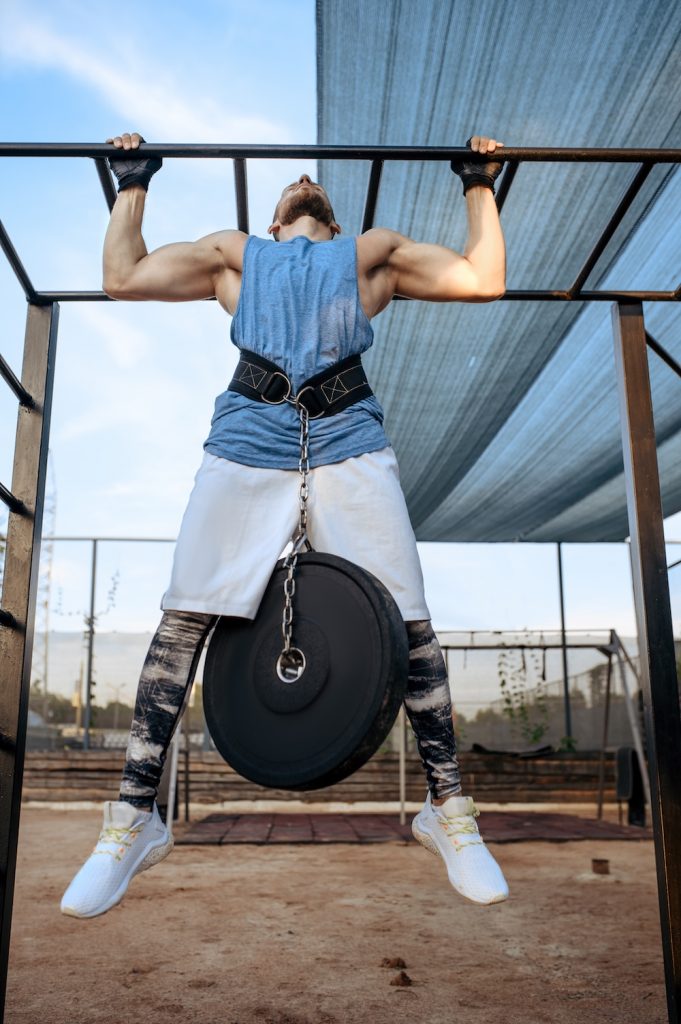
Man does weighted pull-ups
In calisthenics, you can apply progressive overload by:
- Increasing the number of repetitions or sets.
- Decreasing your rest time between sets.
- Increasing the time your muscles are under tension (e.g., performing slower reps or adding pauses).
- Moving to harder exercise variations (e.g., from knee push-ups to standard, then decline, then one-arm push-ups).
- Adding external resistance, such as a weighted vest or ankle weights.
Mechanical tension and muscle damage
Mechanical tension is the primary driver of hypertrophy. It refers to the force applied to muscle fibers, signaling them to grow stronger and larger. Calisthenics movements, especially when performed slowly and with control, can create significant mechanical tension.
Muscle damage, on the other hand, refers to microscopic tears in muscle fibers caused by strenuous exercise. This damage triggers a repair process, leading to muscle growth. You often feel this as delayed onset muscle soreness (DOMS) a day or two after an intense workout.
Metabolic stress: The pump factor
Metabolic stress occurs when metabolic byproducts, like lactate and hydrogen ions, accumulate in the muscles during high-rep sets or short rest periods. This creates a “pump” sensation and contributes to cell swelling, which can also stimulate muscle growth.
Is calisthenics as effective as weightlifting for hypertrophy?
Yes, calisthenics can be just as effective as weightlifting for building muscle, provided you apply the principles of progressive overload and proper programming. Both training modalities stimulate muscle growth via the same physiological pathways.
While very advanced weightlifters might achieve higher levels of resistance for certain isolated muscle groups, calisthenics offers endless progression for most individuals. The benefits of calisthenics extend beyond just muscle size; it also enhances body control, functional strength, and can often reduce the risk of injury when performed correctly.
Crafting your calisthenics muscle-building program
An effective calisthenics program for hypertrophy requires thoughtful exercise selection, optimized sets and reps, and attention to recovery.
Smart exercise selection
Focus on compound, multi-joint movements that engage large muscle groups. These are your foundational exercises for muscle growth:
- Push: Push-ups (and their variations like decline push-ups, pseudo planche push-ups), Dips, Handstand Push-ups.
- Pull: Pull-ups (various grips), Chin-ups, Bodyweight Rows.
- Legs: Squats, Lunges, Bulgarian Split Squats, Pistol Squats.
- Core: Plank variations, L-sits, Leg Raises.
Always start with foundational movements and gradually progress to harder variations as your strength improves.
Optimizing sets, reps, and rest
For hypertrophy, aiming for 6-12 repetitions per set for 3-5 sets is effective. If you can easily perform more than 12 reps, it’s time to move to a more challenging variation or add resistance.
Rest for 60-90 seconds between sets. This allows for sufficient recovery while maintaining enough metabolic stress to stimulate growth.
The role of advanced techniques
To further challenge your muscles and break through plateaus, consider incorporating advanced techniques:
- Drop Sets: Perform a challenging exercise variation until failure, then immediately switch to an easier variation to extend the set.
- Supersets: Pair two exercises back-to-back with minimal rest, often targeting opposing muscle groups (e.g., pull-ups followed by dips).
- Tempo Training: Control the speed of each phase of an exercise (e.g., a 3-second eccentric phase for push-ups).
Nutrition and recovery: The unsung heroes
Muscle growth doesn’t happen during the workout; it happens during recovery. Therefore, nutrition and rest are just as important as your training:
- Caloric Surplus: To build muscle, you generally need to consume more calories than you burn. This provides the energy for muscle repair and growth.
- High Protein Intake: Protein is crucial for muscle repair and synthesis. Aim for 1.6-2.2 grams of protein per kilogram of body weight daily, distributed across your meals.
- Adequate Sleep: Aim for 7-9 hours of quality sleep per night. Sleep allows your body to produce growth hormones and repair muscle tissue.
Overcoming plateaus and ensuring progress
Plateaus are an inevitable part of any fitness journey. Implement smart strategies to keep your progress moving forward.
Tracking your workouts

Young sportive man outdoors training using Caliverse mobile app
Consistent tracking is crucial for applying progressive overload effectively. Log your reps, sets, exercise variations, and rest times.
Without this data, it’s difficult to know if you’re truly progressing or how to adjust your training. Caliverse offers robust features to track your workouts and visualize your progress over time.
Master form and technique
Poor form not only leads to inefficient muscle activation but also increases your risk of injury. Always prioritize quality over quantity.
Focus on engaging the correct muscles and maintaining control throughout the movement. Caliverse’s professional video tutorials and community can provide valuable feedback on your form, leveraging our strength in form correction and skill progression.
Strategic deloads and periodization
Periodically reducing your training volume and/or intensity (a “deload”) every 4-8 weeks can help your body fully recover, prevent burnout, and prepare for further growth.
Periodization involves planning your training cycles to vary intensity, volume, and focus over time, ensuring sustained progress and minimizing overtraining.
How Caliverse helps you build muscle with calisthenics
Caliverse is not just a workout tracker; it’s a comprehensive platform designed to guide your muscle-building journey effectively. We empower you to successfully build muscle with calisthenics through a unique methodology.
- Adaptive Programs: Our intelligent algorithms adjust to your individual progress and goals, ensuring consistent progressive overload without static, one-size-fits-all plans.
- Professional Video Tutorials: Access over 200 expertly guided video exercises to ensure perfect form and understanding of each movement.
- Structured Skill Progression Paths: Caliverse breaks down complex calisthenics skills, like the Planche or Handstand, into achievable steps, helping you build foundational strength and muscle along the way.
- Engaged Community Support: Connect with other athletes, share your progress, and receive valuable feedback on your technique, fostering an environment of continuous improvement.
We differentiate from competitors like Freeletics by focusing on structured skill progression and offering a methodology for growth, not just a tool.
Frequently Asked Questions About Building Muscle with Calisthenics
Can beginners build muscle with calisthenics?
Yes, absolutely. Calisthenics is ideal for beginners as it builds foundational strength and body control. Starting with easier variations and gradually progressing allows for consistent muscle growth without needing prior gym experience, making it accessible to anyone looking to start their fitness journey.
How long does it take to see muscle gains from calisthenics?
Results vary based on consistency, effort, nutrition, and genetics. With dedicated training, proper progressive overload, and a good diet, many individuals can start seeing noticeable muscle definition and strength gains within 8-12 weeks. Long-term consistency yields the most significant transformations.
Do I need equipment to build muscle with calisthenics?
Minimal equipment is often beneficial but not strictly necessary. A pull-up bar, resistance bands, and parallel bars can significantly expand your exercise repertoire and allow for greater progressive overload. However, many effective calisthenics programs can be done with no equipment at all.
What is the best rep range for calisthenics hypertrophy?
For hypertrophy, aiming for 6-12 repetitions per set is generally effective. If you can easily exceed 12 reps with good form, it’s a clear signal to progress to a more challenging exercise variation or incorporate advanced techniques like tempo training or weighted calisthenics to continue stimulating growth.
Is a high-protein diet essential for calisthenics muscle growth?
Yes, protein is vital for muscle repair and growth. Aim for 1.6-2.2 grams of protein per kilogram of body weight daily, distributed across meals. This ensures your muscles have the necessary building blocks to recover from intense training stress and adapt by growing larger and stronger.
Can calisthenics build strength in addition to muscle size?
Absolutely. Calisthenics training inherently builds immense functional strength, body control, and muscular endurance. As you progress to more difficult skills and variations, you’ll develop significant strength alongside muscle hypertrophy, often with improved body awareness and overall athletic performance.
Conclusion
Calisthenics is a powerful, accessible, and highly effective method for building muscle, strength, and an impressive physique. By consistently applying the principles of progressive overload, intelligent programming, and prioritizing recovery, anyone can achieve significant hypertrophy without ever touching a weight.
With its structured approach to skill progression and comprehensive tracking, Caliverse empowers you to confidently navigate your journey to build muscle with calisthenics and unlock your full potential.
About the author : Daniels